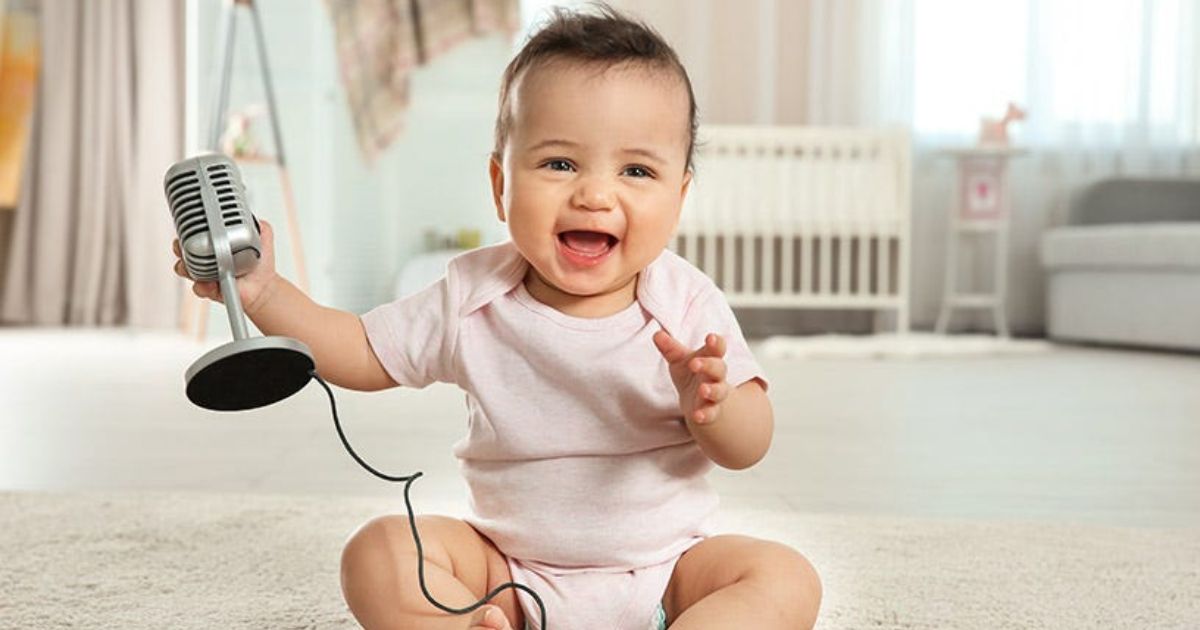
That moment lands like nothing else in early parenthood. One ordinary afternoon, your baby looks up at you and says something that sounds unmistakably real — “mama,” “dada,” “ball,” or even “no.” You freeze. Did that just happen? It did. And the road that led there started months before you even noticed.
Most children speak their first word between 10 to 14 months of age. But the window is wider than most parents expect. Most babies say their first word sometime between 12 and 18 months of age. That’s a range of nearly a year, which surprises a lot of families. The truth is, language doesn’t arrive on a single date. It builds slowly, in layers, long before any recognizable word comes out.
The Language Journey Starts at Birth
Babies are not waiting until their first birthday to communicate. The first “baby talk” is nonverbal and happens soon after birth — grimacing, crying, and squirming to express a range of emotions and physical needs, from fear and hunger to frustration and sensory overload.
This is real communication. The baby is sending messages. You are receiving them. That exchange — even wordless — is the foundation everything else is built on.
Cooing is the baby’s first sound production besides crying, usually occurring between six to eight weeks of age. It’s soft, breathy, and easy to miss if you’re not listening for it. But it signals something significant: the baby is now experimenting with what their mouth and breath can do together.
Around four months, laughter joins the picture. Usually at around 16 weeks, your baby will laugh in response to things in their world. Laughter is not random noise — it is a response to meaning. That laugh tells you the brain is connecting cause and effect through sound.
The Babbling Stage: Months 4–9
Babbling generally occurs around 4 to 7 months. During this time, your baby will begin to produce a variety of consonant and vowel sounds, such as “ba-ba” or “ya-ya,” as they explore the range of sounds their tiny mouths can make.
This is where a lot of parents get excited — and sometimes confused. Some eager parents interpret a string of “da-da” babbles as their baby’s first words — “daddy!” But babbling at this age is usually still made up of random syllables without real meaning or comprehension.
Babbling is not talking. It is practice. Think of it like a musician running scales before learning a song. The sounds are real, the effort is real, but the meaning isn’t there yet.
Babbling and baby jargon — the use of repeated syllables like “bababa” without specific meaning — usually occurs between 6 and 9 months. Babbling then turns into baby jargon, or “nonsense speech.” During this stage, babies start stringing sounds together with rising and falling tones that almost sound like sentences. It can be hilarious and charming in equal measure.
The 9-Month Leap: Understanding Before Speaking
Something shifts around the nine-month mark that parents often overlook. The baby starts to understand language before they can produce it.
After 9 months, babies can understand a few basic words like “no” and “bye-bye.” That matters enormously. Comprehension always leads production. A baby who understands what “no” means, even if they can’t say it yet, is already doing serious language work inside their brain.
By the end of the sixth or seventh month, babies respond to their own names, recognize their native language, and use their tone of voice to tell you they’re happy or upset. These are not small things. Recognizing your own name out of a stream of surrounding noise is a cognitive task that takes real neural organization.
The First Real Word: Around 12 Months
Babies usually say their first word at around the 12-month mark. For some kids it may be a little earlier, and for others it’s a little later. Before turning 1, perhaps your baby was saying “mamama” or “dadada,” but it wasn’t clear if they were referring to a parent or simply babbling away.
The difference between babbling and a first word is intentionality. To count as a word, the child has to use it consistently, independently, and meaningfully with intention. So when your baby says “ba” every single time they see their bottle — and only then — that is a word, even if it doesn’t sound like one to adult ears.
A baby’s first word often includes them saying the words parents love to hear most — “ma-ma” and “da-da.” These sounds dominate early speech across nearly every language in the world, and that’s no accident. The sounds “m,” “d,” and “b” are among the easiest for young mouths to produce. The brain picks the low-hanging fruit first.
Girls may say their first words earlier compared to boys. This is a pattern that holds across many studies, though the gap is modest and evens out over time.
What Counts as a First Word?
Parents sometimes debate this with each other, and it’s worth clearing up. Many types of communication can count as a first word. They include full, real words such as “mama” or “bubble,” word approximations where the child says part of a word like “wa” for water, and even sign language — an example might be making the sign for “more” or “all done.”
This is a more generous definition than most people expect, and that’s a good thing. It means a baby who is communicating with intention — even imperfectly — is right on track.
After the First Word: The Vocabulary Explosion
The first word often arrives quietly. The second and third words trickle in over the following weeks. Then, somewhere between 18 and 24 months, the rate suddenly accelerates.
By the time your baby is a year old, they are probably saying between one to three words. They will be simple and not complete words, but you will know what they mean.
At 18 months old, babies may say anywhere between 10 and 50 words. That is a dramatic range, and both ends of it can be completely normal. The key question, as speech-language pathologist Kaleigh Loeffler of Children’s Health puts it, is not how many words your child has, but whether the number is growing week by week.
How You Can Help
The single most powerful thing a caregiver can do is talk. Not quiz the baby, not drill sounds — just talk. Narrate your day. Describe what you’re doing while you wash dishes or fold laundry. Parents play a pivotal role in their child’s speech development by responding to the child when they make noises, talking clearly and slowly, teaching the child to imitate actions like clapping or waving bye-bye, and singing and reading to the baby beginning at a young age.
Chatting with your baby about even the most ordinary parts of your day can help set your baby up for success. Even though they can’t hold a conversation yet, those early one-sided conversations are crucial.
When to Talk to a Doctor
Knowing the typical window is one thing. Knowing when to seek guidance is another. Speech can be delayed if the frenulum — the membrane that attaches the tongue to the floor of the mouth — is too short, or there’s some other tongue problem. Another cause is psychosocial deprivation, where the adults in the child’s life don’t spend enough time talking to them, slowing speech development. Being a twin is also a factor — studies show twins tend to develop language later than singletons, due to genes and possibly birth complications.
If your child is not producing any words by 16 months, or if they were using words and have stopped, bring it up with your pediatrician. Early intervention makes a real difference. Up to 17% of children in the U.S. have a developmental or behavioral disability such as autism spectrum disorder or cognitive disability, and developmental screening can help catch these early.
Read More: Beautiful 90+ Bhagwan Shayari in Hindi 2026 | भगवान पर विश्वास शायरी
FAQ’s
My baby is 14 months and still hasn’t said a real word. Should I worry?
Not necessarily. If your baby isn’t saying a first word at 12 months, you should not worry as long as they are producing lots of sounds, seem like they are trying to speak, and seem to understand you. If silence persists past 16 months with no attempts at communication at all, that’s worth discussing with a pediatrician.
Does babbling count as talking?
No. Babbling is sound exploration. A real word requires consistent, intentional use tied to meaning. “Dada” said randomly is babbling. “Dada” said every time Dad walks in the room is a word.
Do bilingual babies talk later?
Bilingual babies are sorting out two sound systems at once. They may appear to have a smaller vocabulary in each language separately, but their total combined vocabulary is on par with monolingual peers. Developmental timelines are not significantly different.
What are the most common first words?
Across cultures, names for caregivers dominate — “mama,” “dada,” “nana.” After that, words for familiar objects and actions like “ball,” “no,” “more,” and “up” are among the first to appear. Short, high-contrast words tied to daily routines come easiest.
Language is one of the most human things there is, and watching a baby build it from scratch — from a newborn cry to a purposeful word — is something no developmental chart can fully capture. Your voice, more than anything else, is the tool that makes it happen.
Read More: Heartfullines

Hi, I’m Mohan, and I love writing. I have always enjoyed reading shayari, quotes, captions, and poetry in different languages. I started this website to share meaningful words that help people express their emotions. I spend time researching and collecting lines in English, Hindi, and Marathi that connect with real feelings. My goal is to make it easier for readers to find the right words for any moment or mood.