Learning Math Words That Start With R can make math easier to understand and less intimidating. From basic terms like ratio and radius to advanced ideas like Riemann sum and regression, these words appear across geometry, algebra, statistics, and real-life problem-solving.
This guide explains each term in simple language, with clear examples and practical uses. Whether you’re a student, parent, or teacher, you’ll find helpful vocabulary that builds confidence and strengthens math skills step by step.
Quick List: Math Words That Start With R
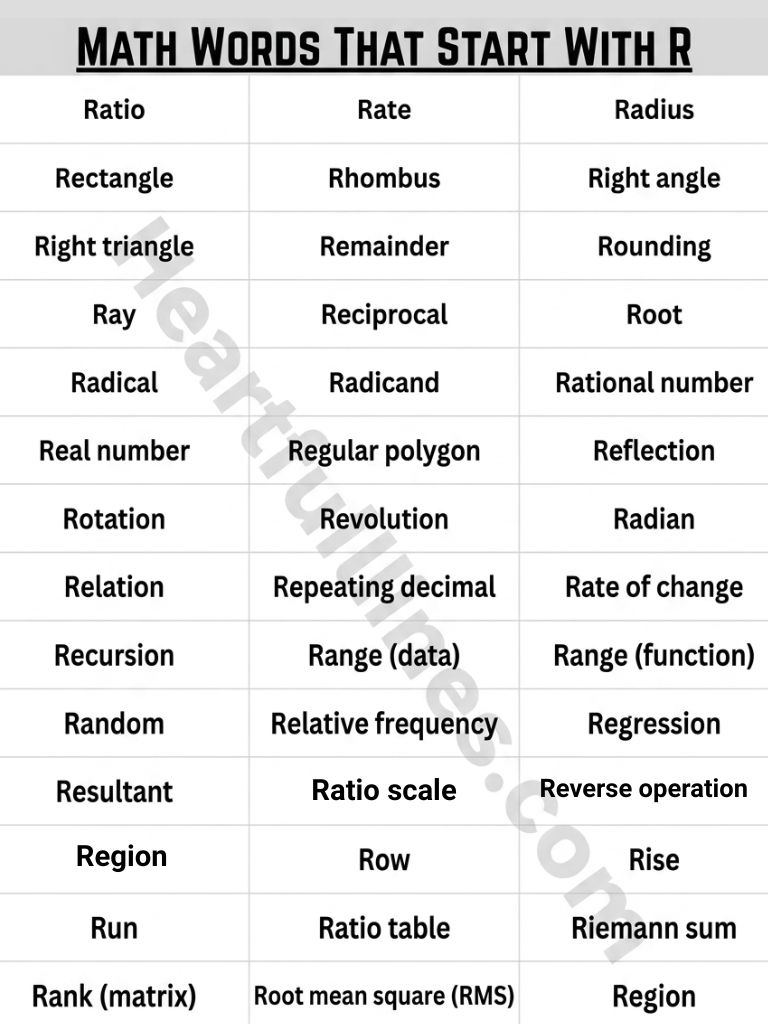
- Ratio
- Rate
- Radius
- Rectangle
- Rhombus
- Right angle
- Right triangle
- Remainder
- Rounding
- Ray
- Reduce (fractions)
- Reciprocal
- Root
- Radical
- Radicand
- Rational number
- Real number
- Regular polygon
- Reflection
- Rotation
- Revolution
- Radian
- Relation
- Repeating decimal
- Rate of change
- Recursion
- Reflexive property
- Range (data)
- Range (function)
- Random
- Relative frequency
- Regression
- Replacement
- Resultant
- Rectangular prism
- Row
- Rise
- Run
- Ratio table
- Riemann sum
- Rank (matrix)
- Root mean square (RMS)
- Rule of 72
- Radius of convergence
- Region
- Reduction (ratios)
- Reciprocal function
- Ratio scale
- Reverse operation
- Rounding error
- Rectangular coordinates
Common Math Words That Start With R
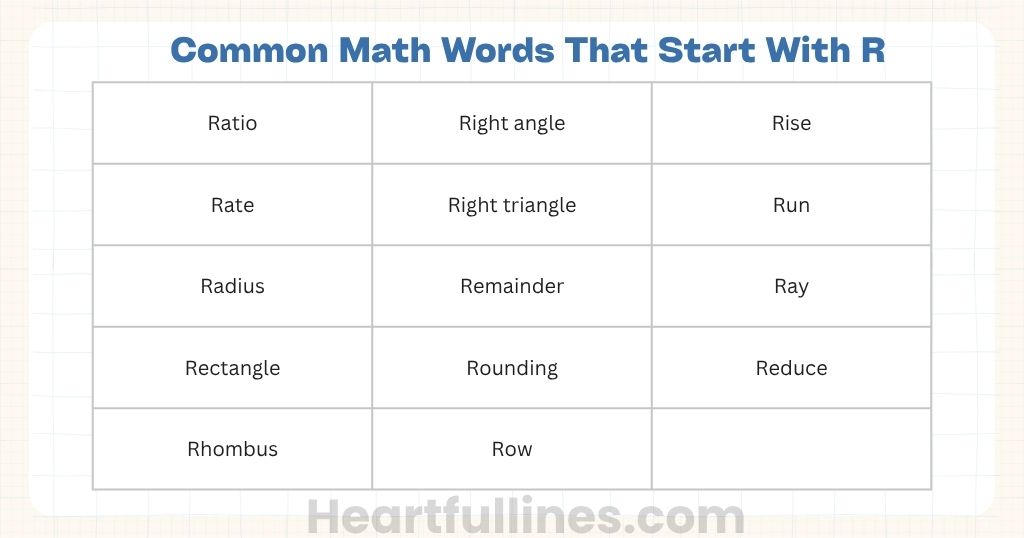
Ratio — Compares two amounts to show how much of one thing there is compared to another. Example: 12 boys and 18 girls gives a ratio of 2:3. Used in recipes, maps, and mixing colors.
Rate — Compares two different kinds of quantities, like distance and time. Example: 60 miles in 1 hour is 60 mph. Helps with speed, pricing, and timing.
Radius — Distance from the center of a circle to its edge. Example: a 6-inch radius means a 12-inch circle. Needed for area and circumference.
Rectangle — A four-sided shape with four right angles and equal opposite sides. Example: a sheet of paper. Basis for area and perimeter problems.
Rhombus — A four-sided shape where all sides are equal, but angles don’t have to be 90 degrees. Example: a diamond on a playing card. Helps tell quadrilaterals apart.
Right angle — An angle that measures exactly 90 degrees. Example: the corner of a book. Building block for squares and triangles.
Right triangle — A triangle with one 90-degree angle. Example: a ramp against a wall. Foundation for the Pythagorean theorem.
Remainder — What’s left over after division. Example: 17 ÷ 5 = 3 remainder 2. Shows up in division and sharing problems.
Rounding — Adjusting a number to a simpler value close to the original. Example: 87 rounds to 90. Makes estimation faster.
Ray — A straight line starting at one point and going forever in one direction. Example: a flashlight beam. Used to describe angles.
Reduce (fractions) — Simplifying a fraction to its smallest form. Example: 4/8 reduces to 1/2. Makes fractions easier to compare.
Row — A horizontal line of numbers, often in a table or matrix. Example: in a spreadsheet, all the values across one line form a row. Used to organize and read data.
Rise — The vertical change between two points on a graph. Example: going from a height of 2 to 6 means a rise of 4. Used to calculate slope.
Run — The horizontal change between two points on a graph. Example: moving from x = 1 to x = 5 is a run of 4. Paired with rise to find slope.
Advanced Math Words That Start With R
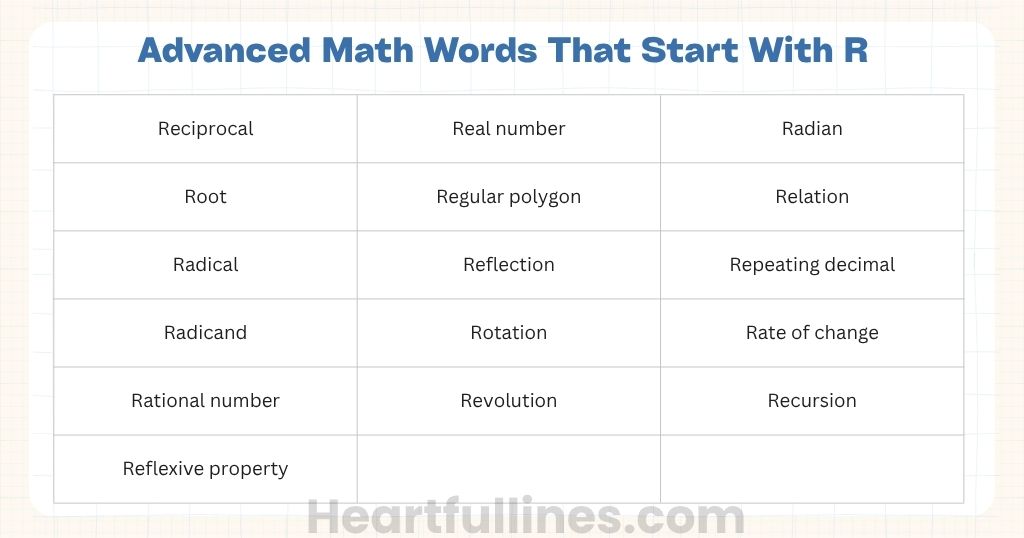
Reciprocal — Flip a fraction’s numerator and denominator. Example: the reciprocal of 3/4 is 4/3. Used for dividing fractions.
Root — A value that, multiplied by itself a set number of times, gives the original number. Example: the square root of 25 is 5. Used to solve equations.
Radical — The symbol (√) showing a root, plus the expression under it. Example: √16 = 4. Common in algebra formulas.
Radicand — The number under a radical sign. Example: in √49, 49 is the radicand. Helps simplify square roots correctly.
Rational number — Any number that can be written as a fraction of two whole numbers. Example: 0.5 = 1/2. Helps classify numbers.
Real number — Includes all rational and irrational numbers, basically any number on a number line. Example: 7, -3, 0.25, π. Foundation of most operations.
Regular polygon — A shape with all sides and angles equal. Example: a regular hexagon, like a stop sign shape. Follows predictable area and angle rules.
Reflection — Flipping a shape over a line to create a mirror image. Example: your reflection in a mirror. One of the basic transformations.
Rotation — Turning a shape around a fixed point by an angle. Example: clock hands moving around the center. Used to describe symmetry and movement.
Revolution — One complete turn around a circle, equal to 360 degrees. Example: a wheel making one full spin is one revolution. Used alongside rotation in geometry.
Radian — A unit for measuring angles based on a circle’s radius. Example: a full circle is about 6.28 radians. Heavily used in trigonometry.
Relation — A set of paired inputs and outputs. Example: (1,2), (2,4), (3,6) shows each number doubled. Stepping stone to functions.
Repeating decimal — A decimal where digits repeat forever. Example: 1/3 = 0.333… Helps convert between fractions and decimals.
Rate of change — How much one quantity changes compared to another, often shown as slope. Example: a plant growing 2 inches per week. Core idea behind slope and calculus.
Recursion — A sequence where each term is based on the one before it. Example: 2, 4, 8, 16 — each number doubles the last. Used in patterns and programming.
Reflexive property — States that any value equals itself (a = a). Used as a basic building block in geometric proofs.
Geometry Math Words That Start With R
- Rectangular prism — a 3D shape with six rectangular faces, like a shoebox
- Region — a bounded area, often used when describing space between curves or shapes
- Rectangular coordinates — points described using x and y values on a grid, like (3, 5)
Statistics and Probability Math Words That Start With R
Range (data) — The difference between the highest and lowest values in a data set. Example: in 4, 9, 15, 22, the range is 18. Shows how spread out data is.
Range (function) — The set of all possible output values a function can produce. Different from range in statistics, even though the name is the same.
Random — An outcome with no predictable pattern. Example: rolling a die. Basis of probability.
Relative frequency — How often something happens compared to the total number of trials. Example: getting heads 45 times out of 100 flips gives a relative frequency of 0.45.
Regression — A method for finding the relationship between two sets of data. Used to predict trends, like how study time relates to test scores.
Replacement — In probability, putting an item back before picking again. Changes whether outcomes stay independent.
Resultant — The combined effect of two or more vectors. Example: combining a push north and a push east gives one resultant direction and strength.
Root mean square (RMS) — An average that squares values first to handle both positive and negative numbers. Used in statistics and engineering.
Algebra and Higher Math Terms Starting With R
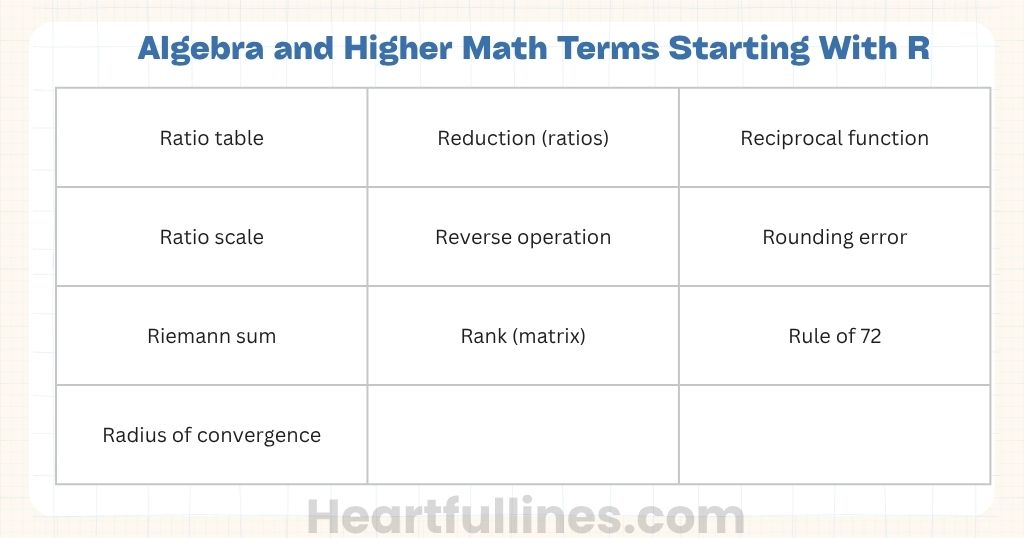
Ratio table — A table showing pairs of numbers that share the same ratio, used to find equivalent ratios quickly.
Reduction (ratios) — Simplifying a ratio to its smallest whole-number form, similar to reducing a fraction. Example: 10:20 reduces to 1:2.
Reciprocal function — A function written as 1 divided by another function, such as f(x) = 1/x. Its graph forms a curve that never touches the axes.
Ratio scale — A measurement scale with a true zero point, where ratios between values are meaningful. Example: weight and height are ratio scales; temperature in Celsius is not.
Reverse operation — An operation that undoes another, such as subtraction reversing addition, or division reversing multiplication.
Rounding error — The small difference between a rounded number and its exact value. Adds up when used in multiple calculations.
Riemann sum — A method for estimating the area under a curve using small rectangles. Foundation for understanding integrals in calculus.
Rank (matrix) — The maximum number of independent rows or columns in a matrix. Used to solve systems of equations in linear algebra.
Rule of 72 — A quick way to estimate how many years an investment takes to double, by dividing 72 by the interest rate. Practical shortcut in finance.
Radius of convergence — The range of values for which an infinite series adds up to a finite number. Used in advanced calculus with power series.
Where R Math Words Show Up in Real Life
- Cooking: ratios scale recipes up or down
- Driving: rate (speed) shows how fast you’re going
- Construction: right angles and rectangles keep walls straight
- Shopping: rounding helps estimate a total bill quickly
- Sports: range and relative frequency compare player stats
- Finance: the Rule of 72 shows how savings grow over time
Tips for Remembering R Math Words
- Group words by topic — geometry, algebra, statistics — instead of memorizing them all together
- Sketch a picture for shape words like rectangle, rhombus, and right triangle
- Use each word in a sentence about something familiar, like your room or allowance
- Make flashcards with an example on one side, not just a definition
Commonly Confused Terms
Ratio vs. Rate — A ratio compares two similar things; a rate compares two different units, like miles and hours.
Radius vs. Radian — A radius is a length. A radian is an angle measurement. Different things, similar sound.
Rational number vs. Real number — Every rational number is real, but not every real number is rational (like π).
Reflection vs. Rotation — A reflection flips a shape like a mirror. A rotation spins it around a point without flipping.
FAQs
Why do ratio and rational number sound so similar?
They share a root meaning “proportion.” A rational number is one that can be written as a ratio of two whole numbers, so the connection is real, not random.
Is radius used the same way in 3D shapes?
The idea stays the same — distance from center to edge — but in 3D shapes like spheres, it’s used to find volume and surface area instead of just circumference.
Why does rounding sometimes make totals look “off”?
Rounding is for estimation. When several rounded numbers are added or multiplied together, small differences can stack up, creating a noticeable rounding error.
What’s the difference between a repeating and a terminating decimal?
A terminating decimal ends, like 0.25. A repeating decimal continues with a pattern forever, like 0.666… Both can usually be converted to fractions, but the methods differ.
Final Thoughts
Understanding Math Words That Start With R is about more than memorizing definitions. These terms help explain patterns, shapes, measurements, and data that appear both in school and everyday life. Start with the words you see most often, practice them through examples, and build from there. A strong math vocabulary makes learning easier, improves problem-solving skills, and helps you feel more confident whenever numbers are involved.
For more vocabulary lists, and word guides, visit HeartfulLines.

Hi, I’m Mohan, and I love writing. I have always enjoyed reading shayari, quotes, captions, and poetry in different languages. I started this website to share meaningful words that help people express their emotions. I spend time researching and collecting lines in English, Hindi, and Marathi that connect with real feelings. My goal is to make it easier for readers to find the right words for any moment or mood.